
RACE IT HOME
What if you could race a Hot Wheels car without opening the pack?
An immersive commerce experience case study about using AR and interaction design to make a product drop more engaging for the people who collect and play with it.
IMMERSIVE COMMERCE
PRODUCT THINKING
INTERACTION DESIGN
MY ROLE
Product & Interaction Design and Development
TEAM
Digvijay Shelar, Vibha Shree M S
COURSE
Interaction Design for Immersive Systems
DURATION
2 weeks
*Unofficial concept. Not affiliated with Blinkit or Mattel.
02
Hot Wheels are made to be played with. Collecting changes that.
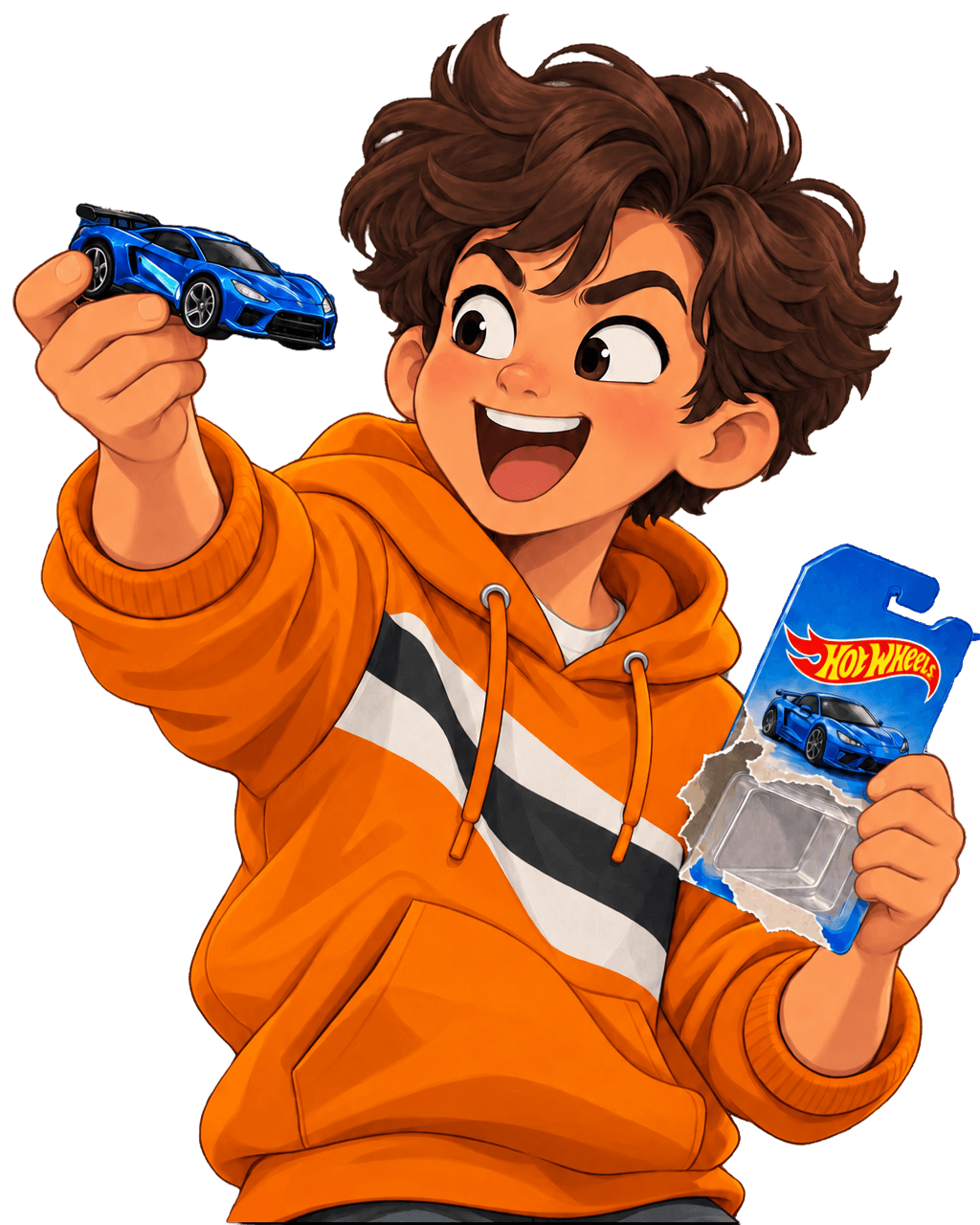
The project started with a disagreement. Vibha excitedly showed me her carefully kept Hot Wheels collection. It felt completely different from how I’d always experienced Hot Wheels. I’d grown up opening them, racing them, and actually playing with them. It was the first time I saw someone value the cars just as much by keeping them sealed.


PLAY
Me
I’m not a Hot Wheels collector. To me, the value is in opening the car, moving it and playing with it.

PRESERVE
Vibha
Vibha is a collector. For her, rarity, condition and keeping the card intact are part of what makes the car valuable.

So before designing anything, we asked:
Was this just us?
PRIMARY RESEARCH · 37 COLLECTORS SURVEYED - r/HotWheelsIndia
37 adult Hot Wheels enthusiasts and collectors across India.
54%
open the car
and play with it

24%
Prefer keeping
it Sealed

16%
buy two, one to open
and one to preserve
Single choice. A further 5% said it depends on how rare the car is.
There was no single way to enjoy Hot Wheels. The experience had to make space for both.
That gave us a clearer question:
How might we give a Hot Wheels car the excitement of being played with, without asking a collector to sacrifice the thing they value most: keeping it sealed?
What did that mean for the experience?

SEE IT
Understand the car beyond a flat product photo.

KEEP IT INTACT
Don’t force the collector to open what they value.

EXPERIENCE IT
Still give the car a sense of play.
WHY AR WAS WORTH TESTING
AR gave us a way to bring the car into someone’s space without opening the pack. These examples showed that virtual product interaction was familiar enough to test.

38.6M
Virtual try-ons at Lenskart
in India during FY25
Virtual product interaction was already happening at scale.

1 in 3
Indian shoppers prefer
virtual trials
Half of these users report significantly higher online spending.

250M+
Monthly Snapchat users
in India, 2025
Nearly 80% of Indian Snapchatters use Lenses daily.
These signals supported an AR experiment, not proof that it would work for Hot Wheels. We still had to test whether placing the car in a room gave people something worth doing.
03
So we built the simplest test possible: bring the car into your space.
Our first prototype was deliberately simple.
We placed the car into a real room in AR and let the player move it forward, backward, left and right.
It worked. But nothing really happened.
THE FIRST AR PROTOTYPE · SHOWN AS IT WAS BUILT

AR PLACEMENT
The car dropped into the
room on a detected surface.

FREE DRIVING
Forward, back, left, right. No track and no objective.
What was lacking?
No destination
No challenge
No progression
No reason to return
What next?
AR made the car feel present. It still didn’t give the interaction a purpose.
We had put the car in AR. Now we had to give it somewhere to go.


04
We gave the car somewhere to go.
A track gave the interaction a beginning and an end.
But making it a race also meant questioning how every action should feel.
FROM A LOOSE CAR TO A CIRCUIT · REAL BUILDS, IN ORDER

FIRST CIRCUIT
A closed loop on a real table. Somewhere to go, and a finish.

PICKUPS AND STEERING
Groceries to collect, so the lane you pick starts to matter.

THE CONTROLS TODAY
Three gestures, taught in one card before the countdown.
Three control decisions
01
LAUNCH
BEFORE

→
AFTER


A race that simply began became a lever you pull.
The gesture now matched the action.
02
STEER
BEFORE

→
AFTER


Invisible hold zones became tilt, with left and right pads you can actually see.
Less correction. Easier to understand at speed.
03
JUMP
BEFORE

→
AFTER


Aiming at a gate became a hoop you jump through.
One physical gesture could explain ramps and rings.
04 · GAME DIRECTION
One camera angle could not explain every moment, so the view changes with what the car is doing.

LAUNCH
The road ahead, so you know where you are going.

RACE
Behind the car, so you can read what is coming.

JUMP
Side on, so the air time is actually visible.

LOOP
Side on, so the whole curve stays readable.
The camera should explain what is happening, not compete with it.

This is where the play started to feel real.
05
Then we came back to where we started.
The race solved the play side of the problem.
But our original disagreement was never really about whether playing or preserving was better. It was about designing for both.
VIEW IT
Place → Explore → Rotate → Zoom

AR IN YOUR SPACE

3D FALLBACK
Place the car in your room with AR. Keep the 3D viewer as a secondary fallback.
PLAY IT
Launch → Steer → Collect → Jump → Race

THE START LINE
THE LOOP
Race across your room, collect groceries and drive through the loop.
In the end, we didn’t ask collectors to stop being collectors, or players to stop wanting to play.
We gave each a mode that respects why they care.
06
The interaction worked. Now we needed to find where it belonged.
Our survey gave us the first clue.

70%


already buy Hot Wheels through quick-commerce platforms.
*from our survey data
That meant we didn’t need to invent a completely new destination for the experience.
So why Blinkit?


Hot Wheels die-cast cars are also already sold on Blinkit, so the product did not need a new shelf.

774 SKUs
Hot Wheels products listed on Blinkit, more than any other quick commerce platform in India.
Hot Wheels SKUs by quick-commerce platform
SKU COUNT
774
455
379
240
57
That made Blinkit more than a storefront for the idea. It gave the interaction a believable home.
Blinkit also stood out because it already treats interaction as part of shopping.

SCREAM FOR
ICE CREAM
Scream into the phone. The app turns how loud you were into the discount.

DOORBELL SOUND PREVIEW
Hear the bell on the product page, before deciding to buy it.

BLINKIT’S OWN APP
Interaction is already part of shopping here.
Two interactive moments already lived inside Blinkit. That made the app a believable home for the campaign.
✓
A banner that says Play Now, not Buy Now.
✓
Designed to live inside Blinkit; tested through a linked web MVP.
✓
A product page already does more than show a photograph.
So Blinkit became our canvas. Now we had to make the idea fit.

07
Then we accidentally designed an entire Hot Wheels app.
Our first Blinkit version kept growing.
Campaign home. Car selection. Race setup. Leaderboard. Rewards. Invites. Separate social screens. Each feature made sense on its own. Together, they stopped feeling like something inside Blinkit.
V1

CAMPAIGN HOME

CAR SELECTION

RACING REWARDS

LEADERBOARD

INVITE A FRIEND
Directional feedback from people who tried it

“This feels like a Hot Wheels app, not something inside Blinkit.”
We looked again at the flow and at how lightweight commerce campaigns usually behave. Instead of adding another feature, we removed them.
Removed:
Car-selection destination
Standalone rewards / invite pages
Separate leaderboard
Extra campaign navigation
Added in the Result:
Score + personal best
Embedded leaderboard
Race allowance + share
Direct route to the shop
08
What we finally designed
The final experience came down to three moments.

BLINKIT HOME
AR RACE

RESULT
WHY IT STARTS ON THE HOME SCREEN
FOUND BY CHANCE
30%
found the earlier drop in the app by chance.
REACHED BY NOTIFICATION
8%
heard about it through an app notification.
THE DESIGN DECISION
Give the campaign a visible place on the home screen, so discovery doesn’t depend on chance or a notification people might miss.
THE BEST ITERATION WASN’T ANOTHER FEATURE.
IT WAS SUBTRACTION.
What the campaign looks like

We kept the experience deliberately limited. Three daily races give a player room to improve a score without turning the campaign into a full-time game.
After your 3 daily races, invite a friend to race and unlock 1 extra race.

AR RACE
Race through the room, collect Blinkit groceries, clear the loop and avoid debris.
RESULT
See your score, personal best, leaderboard and races remaining.

AFTER 3 DAILY RACES
Invite a friend, unlock one more race.

SHOP
Hot Wheels remain one tap away from the result.
We weren’t redesigning stock allocation, bots or scalping. We were designing the experience around the product.
Play creates the interest.
Commerce stays one tap away.

WHAT COULD THIS CHANGE FOR BLINKIT?
Because this is a commerce feature proposal, we also defined the behaviours the experience would need to influence for Blinkit. These are hypotheses, not measured outcomes.
PLAY
RETURN
INVITE
SHOP

01
ENGAGEMENT
Would the race give people a reason to return for race 2 and race 3?

02
REFERRAL
Would inviting a friend create additional participation in the campaign?

03
COMMERCE
Would playing lead to more product exploration, add-to-cart or purchase?
These are intended outcomes, not claimed impact. A live pilot would be needed to measure whether the experience actually changes shopping behaviour.
09
With the experience focused, we built it for real.
We couldn’t build inside Blinkit, so we shipped a standalone web MVP from a link..The overall project ran for 2 weeks. The final coded prototype was built during a 3-day production sprint.
Built in 3 days, in parallel
We worked in parallel, not in silos.
01
Build & Develop
Digvijay focused on building the working prototype, interaction mechanics and 3D integration making sure the system works as it is intended to work and matches the UI.
→
02
Analyze & Design
Vibha generated 3D assets and continuously audited the UI to match Blinkit’s design, as Blinkit doesn’t have a public Design System. We analyzed existing patterns, built component references and created a consistent visual direction for the experience.
UI Audit
3D Assets
Visual Direction
Consistency

→
03
Test, Deploy & Learn
We deployed the same repository on multiple platforms to find what worked best for our use case. This also helped us learn about real-world deployment and performance.
Vercel
Netlify
Cloudflare


Claude
▾
Working Prototype
✓
AI accelerated production.
Design judgement stayed with us.

Claude helped with implementation, debugging and asset workflows. We manually reviewed the interactions and UI against our Blinkit references.
REFERENCE
PROMPT
BUILD
AUDIT
CORRECT
REPEAT
THE AUDIT PASS
Claude did not design this alone.
We used Claude throughout the process to generate, iterate and audit faster. But every output was reviewed, challenged and refined against the Blinkit experience.
01
Audit with AI
Hundreds of screens. One visual language.
We used Claude to speed up repetitive UI audits, identify inconsistencies and document patterns across Blinkit screens. Every suggestion was manually checked against the actual product.
Audit focus
Spacing
Typography
Components
Consistency

Audited against the Blinkit app, screen by screen, with no design system to reference.

Hundreds of audits, and a few million tokens
02
Design with intent
A few million tokens later, the decisions were still ours.
Claude helped us explore variations quickly, but the final interaction, hierarchy, spacing, visual direction and component choices were designed and refined manually.
What we refined
Interaction
Visual hierarchy
Components
Visual direction
The takeaway
AI gave us speed. Design judgment gave us direction.
Claude made the heavy lifting easier. The experience still reflects our design thinking, craft and understanding of Blinkit.
Then the build exposed what Figma couldn’t.
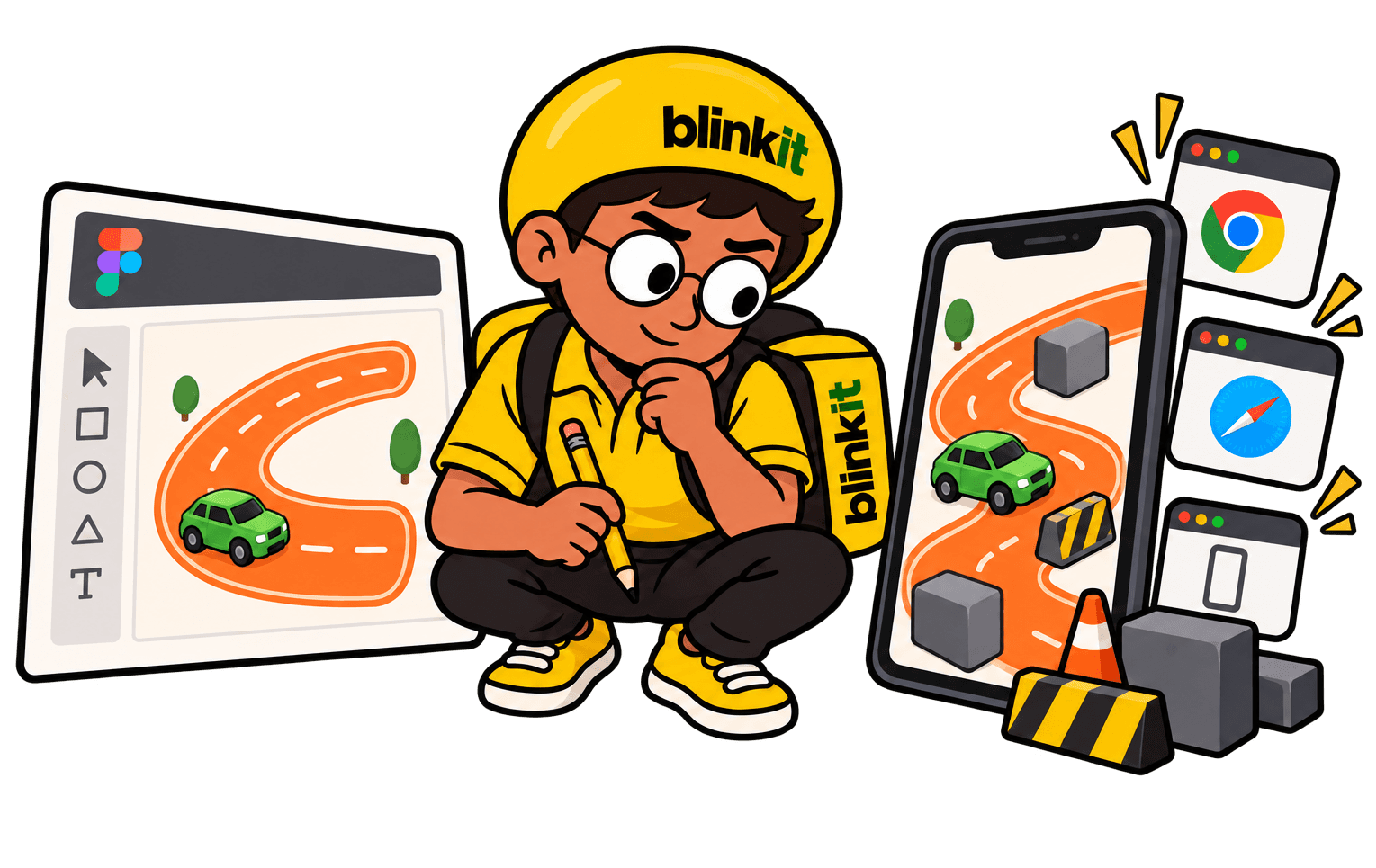
We built this as a web app, not inside Blinkit's app. What each phone can do depends on its browser, so the same race runs in one of three ways.
FULL AR
Android Chrome finds the floor, so the track stays where you put it when you walk around it. This is the version the whole idea is built for.
CAMERA MODE
The track floats over your room.
iPhone Safari cannot find the floor. You still see your room and the view tilts as you move, but the track does not lock to the ground. We never call this AR.
PLAIN 3D
The race without the camera.
If there is no camera, or the check takes longer than four seconds, the 3D race starts instead. Nobody waits on a loading screen.
Same race, three ways to play it. No phone gets a dead end.
Figma proved the idea. Building it exposed the constraints.
10
The prototype worked.
The campaign still has questions.
What I’d test next
01
Repeat play
Run a pilot with more collectors. Measure the share of race 1 players who start race 2 and race 3.
02
Shopping behaviour
Track invite-to-play and play-to-product conversion, then follow product views through add-to-cart and purchase.
03
Technical readiness
Test device compatibility and AR tracking in real rooms. Estimate the effort to produce approved 3D assets and maintain the campaign.
IN THE END
We started by trying to put a Hot Wheels car into AR. That became the least interesting version of the project.
The stronger experience appeared when the technology gained a purpose, first through the interaction, then through the product, and finally through the context it lived in.
The project also reminded me that the right iteration is not always adding more.
Sometimes it is knowing what to remove.
TRY IT YOURSELF
Scan to race it on your phone.
The prototype runs in the browser. WebXR gets spatial placement, iOS uses camera mode, and everything else gets the 3D race.


Or try it right here.
This is the live build running inside the phone. Scroll it, tap through it and start a race.
There is no floor for the camera to find, so the race runs in plain 3D. Every screen and the full flow are the real thing.
Open the link or scan the QR above to race on your own floor in AR.

