Race It Home · Deep dive 01
The research behind the decisions.
Only the findings that changed something. Each one is followed by the decision it produced.
Self-reported answers from a small, self-selected sample. Directional, not representative.
Fifty-eight years of the same idea.
Hot Wheels has always been a physical toy that becomes an experience once there is a track. That is the thread we pulled on.
What it changed
The track is what turned a small metal car into a thing you do. Race It Home is that same move, made digital.
Who answered.
Adult collectors with real collections, concentrated in metros. Our sample skewed heavily toward adult enthusiasts, not children.
are aged 18 to 34. 30 of 37.
started collecting in the last two years.
are based in metro areas. 27 of 37.
Primary audience
Adult Hot Wheels enthusiasts and collectors looking for specific castings.
Secondary context
Casual buyers, gifting and younger users may encounter the experience, but they were not the primary research sample.
What it changed
We stopped designing for “people who buy toys” and started designing for someone looking for one particular casting.
Why they buy.
People buy the car they love, not the rarest one. So collectors needed a way to see it up close.
What makes you buy a particular car? · Choose all that apply · n = 37
Why collectors get a 3D view
buy a car because they love the real one it’s modelled on. 28 of 37.
Details matter
They’re buying the casting, so they need to see every detail.
View it
Place the car in your room, rotate it and zoom in. The pack stays sealed.
What it changed
Only 22% picked rarity. 76% picked the real car. So we built View it: a 3D car collectors can explore without opening the pack.
Open it, or keep it sealed.
The disagreement the whole project started from, put to 37 people. Neither side won.
What do you do with a car you buy? · Single choice · n = 37
What it changed
A single mode would have alienated a quarter of them. This is where View It and Play It came from: two ways in, one product.
What collecting feels like.
Six themes came out of the open answers. Together they explain why a product photograph was never going to be enough.
Nostalgia & family
“My father used to bring them for me on his way home from work.”
Each car carries a memory. The emotional value is bigger than the price.
Love of real cars
“I just love cars. So I collect miniatures of them.”
Collectors buy the car, not the toy. Seeing the car clearly matters.
The thrill of the hunt
“Saw a Batmobile, loved the hunt.”
Searching is part of the fun. The goal is to keep the thrill, not the pain.
A fair price, or nothing
“I don’t like to overpay even a little bit now.”
Collectors protect the hobby. Fair access at MRP builds trust.
Play vs display
“One I can store in mint condition and one I can enjoy my time with.”
Collectors want to enjoy the car without losing its value.
Timing & location
“They go out of stock before I even see they are available.”
Where you live and when you look decide who gets the car.
Verbatim answers from the open-response questions, n = 37.
What it changed
Collectors buy the casting because they love the real car, and they want to enjoy it without losing its value. That is the whole argument for View It and Play It.
Who has a stake in the drop.
Every group the drop touches, and how closely each one needs to be involved.

Stakeholder map and an influence against interest matrix. Adult collectors are the primary user. Resellers sit in the map because they work against fair access, not because the concept addresses them.
What it changed
Adult collectors sit at the centre, and Blinkit product, tech and Mattel are the groups to decide with. That is why the concept had to work inside the existing app rather than beside it.
Where the hunt already happens.
We did not have to invent a destination. Quick commerce was already the second shop.
Where do you usually buy Hot Wheels? · Choose all that apply · n = 37
86% buy from two or more places. Quick commerce is the second shop, six points behind the local toy shop and ahead of Amazon.
What it changed
The experience did not need a new app. It needed to sit inside one collectors already open.
Why Blinkit became our canvas.
Quick commerce told us where the experience could live. Blinkit gave us a precedent for how interaction could behave inside commerce.
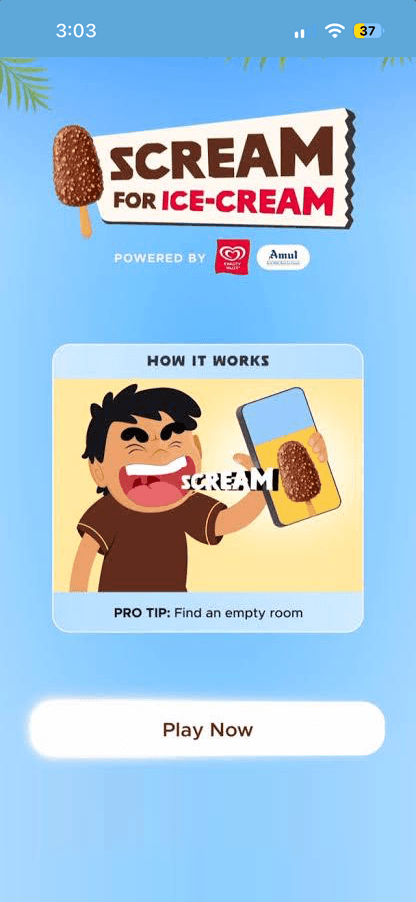
01 · Scream for ice cream
Interaction itself became part of the campaign. The user had to physically interact with the phone rather than simply tap a banner.

02 · Doorbell sound preview
The product page already uses interaction to help someone experience a product before deciding to buy.
How the channel became the canvas
Blinkit is not the only platform that could host this. It is the one with a visible precedent for interaction inside the shopping flow.
Hot Wheels products listed on quick commerce · National SKU count
 Blinkit799
 Swiggy Instamart457
 Zepto383
 BigBasket240
 Flipkart Minutes36
QuickCommerceData, 27 September 2026. Blinkit lists more Hot Wheels products than any other quick commerce platform in India, and 1,915 are listed across the five together.
What it changed
We stopped treating Race It Home as a separate Hot Wheels destination. The interaction had to feel like something that could naturally live inside Blinkit.
Quick commerce drops are already in the journey.
Collectors knew the drops existed. Discovery was fragmented: 30% found the drop by chance, while only 8% heard about it through an app notification.
already knew the drops existed.
had tried a drop at least once.
who tried a drop still missed out.
How did you first hear about the drop? · Tick all that apply · n = 37
What it changed
Awareness was never the gap. The campaign needed a visible place inside the app rather than relying only on passive discovery.
What the earlier drop left open.
Zepto had already run Hot Wheels drops before we started. They created demand. They did not create an experience.
What Race It Home does not solve
Bots, scalping, queueing, purchase limits, stock allocation and fair access. None of these are touched by this project. They are the context the drop happens in, not the problem we designed against.
The three gaps we could actually design for
No anticipation, so there is no reason to open the app early.
Nothing to explore, so the casting itself does no selling.
Nothing to plan around, so it cannot build a habit.
What it changed
We did not try to fix allocation. We designed the experiential layer around the product.
The audience was already growing.
Search interest in Hot Wheels inside India has risen steadily for five years, and most of that rise happened in the last two.
Hot Wheels · Search interest in India · Sep 2021 – Sep 2026
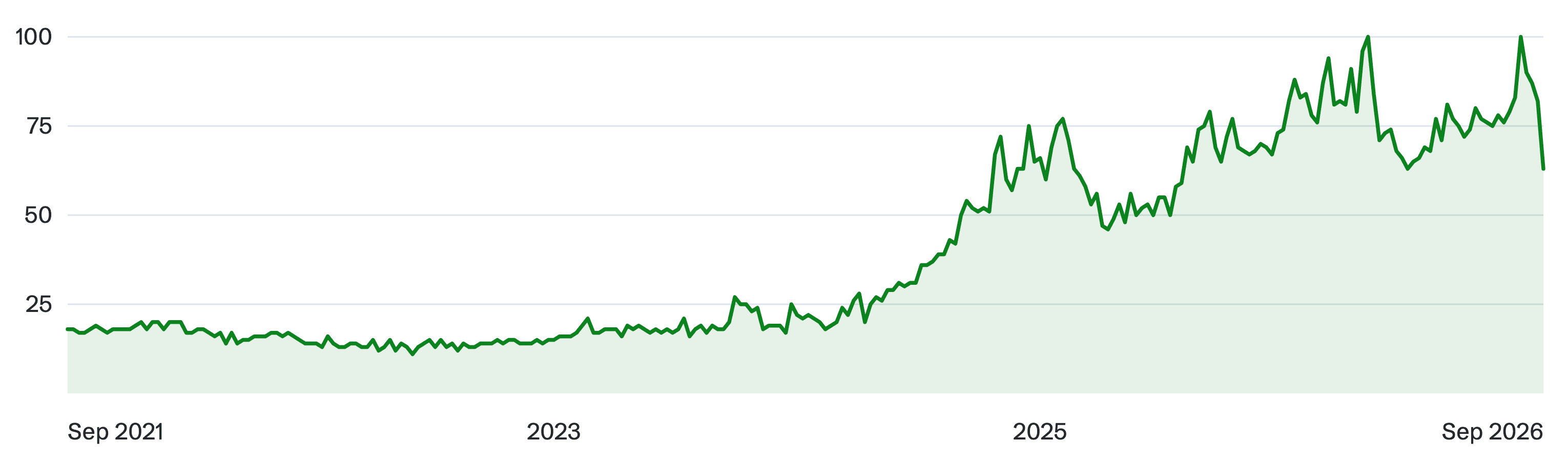 Google Trends, web search, India, past five years. Values are indexed 0–100 against the period peak, not absolute volume. ↗
Weekly search interest in India · Indexed 0 to 100
4.6 times the weekly index of the first year in the window. Indexed interest, not search volume.
Two more checks we ran
Same window, measured as a topic rather than a search string.
Measured as a topic rather than a search string, the weekly index moves from 13 to 69, a 5.3× rise. A second directional check, not another measure of absolute volume. ↗Where the interest is · Top 5 of 35 subregions
Google Trends, web search, India, past five years. Indexed 0 to 100 against the leading subregion, not absolute volume.
What it changed
Interest was already rising. The concept did not need to manufacture interest from zero.
India adopted AR commerce a while ago.
Camera-mediated interaction is ordinary behaviour for the exact age group that collects die-cast.
Monthly active Snapchat users in India, 2025. Around 80% of Indian users engage with Lenses daily.
Snap Inc. ↗Virtual try-ons on Lenskart in India during FY25. AR commerce at real scale, not concept scale.
Lenskart DRHP, FY25 ↗Indian shoppers say they prefer virtual trials. About half of those raise their online spend.
Google – Deloitte, 2026 ↗What it changed
Camera-based and virtual product interaction was already familiar enough to treat immersive interaction as a plausible behaviour, rather than something completely foreign to users.
Could immersive interaction affect commerce?
One retailer published what happened when product pages became explorable rather than photographed.
Reported likelihood vs photographs alone · Baseline indexed to 100
Important
These are category-specific results from another retailer. They show that richer product interaction can influence shopping behaviour in some contexts. They are not a predicted uplift for Hot Wheels or Blinkit.
What it changed
It gave us enough evidence to treat commerce impact as a hypothesis worth testing, not an outcome we could claim.
A lightweight production model could look like this.
How Lenskart’s 3D try-on appears to work from the outside, and the same model applied to a Hot Wheels drop.
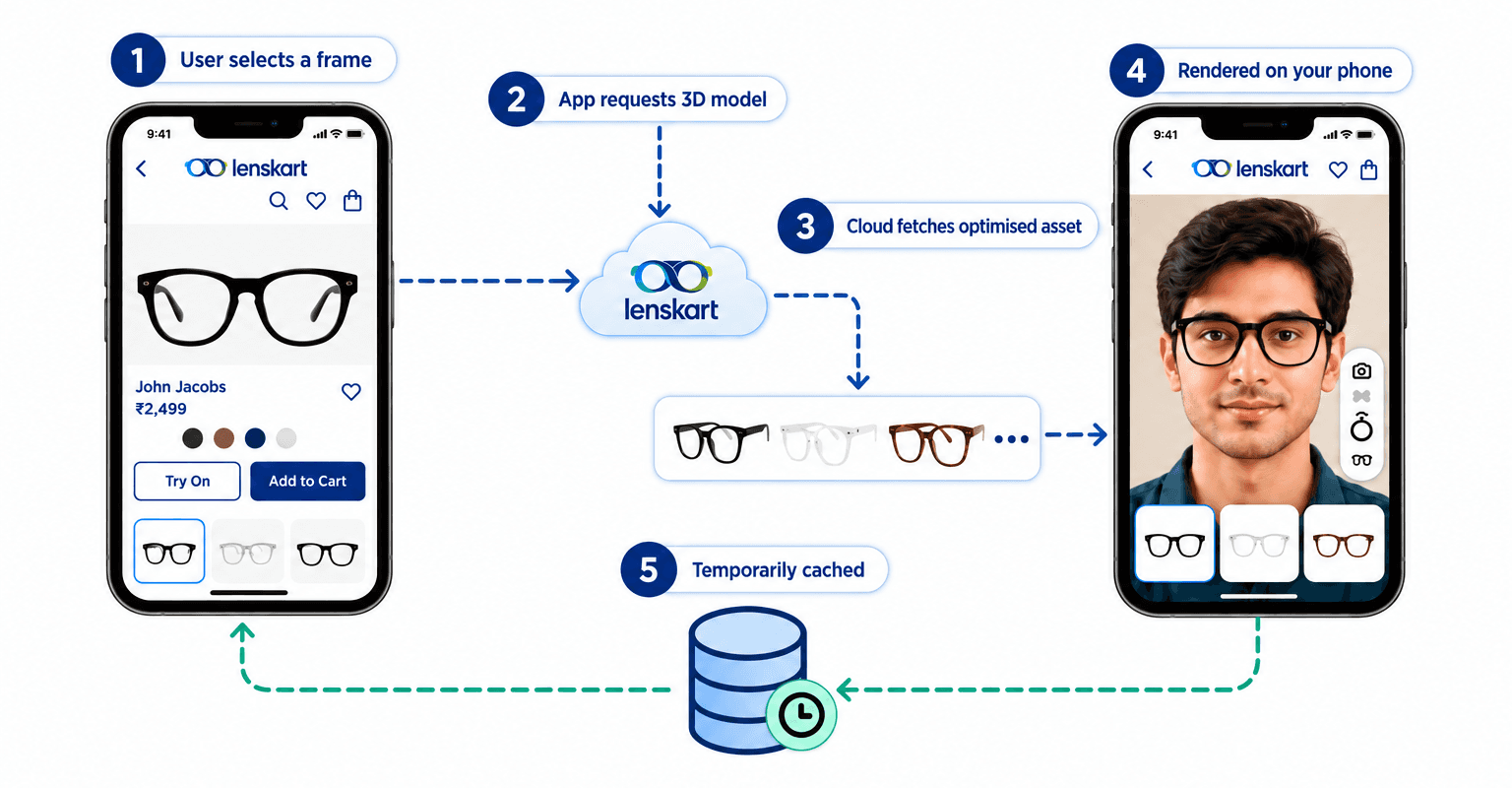
The technology behind it
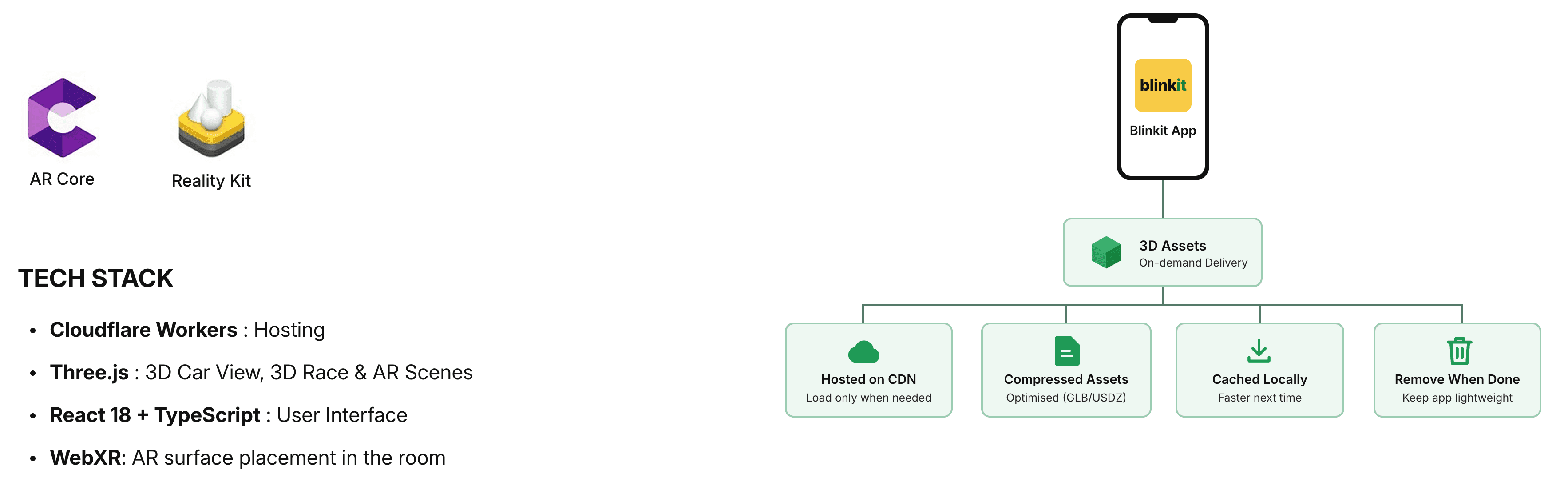
This is a design hypothesis for how the experience could be delivered efficiently, not a reconstruction of Lenskart’s internal architecture.
Campaign 3D assets stay outside the core app, load only when needed, and are removed after the campaign.
One compressed model per product, GLB for Android and USDZ for iPhone, sized for a phone rather than a workstation.
The second look is instant, which is what makes browsing feel normal.
No separate app and no separate mode. It is one tap from the price.
What it changed
We designed the experience around on-demand product assets rather than assuming every 3D model would ship inside the core app.
Could we actually build it?
The last check before committing. AR on the web is not one capability, so we planned for three outcomes instead of one.
Full AR · Android
Android Chrome runs WebXR on Google’s ARCore. The track locks to your floor and stays put as you walk around.
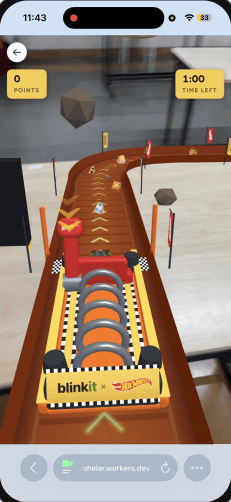
Camera mode · iPhone
iPhone Safari has no WebXR AR, so the track floats over the camera view. A native app would use ARKit.

Plain 3D · Any device
No camera, or camera access declined? The same race opens in 3D straight away.
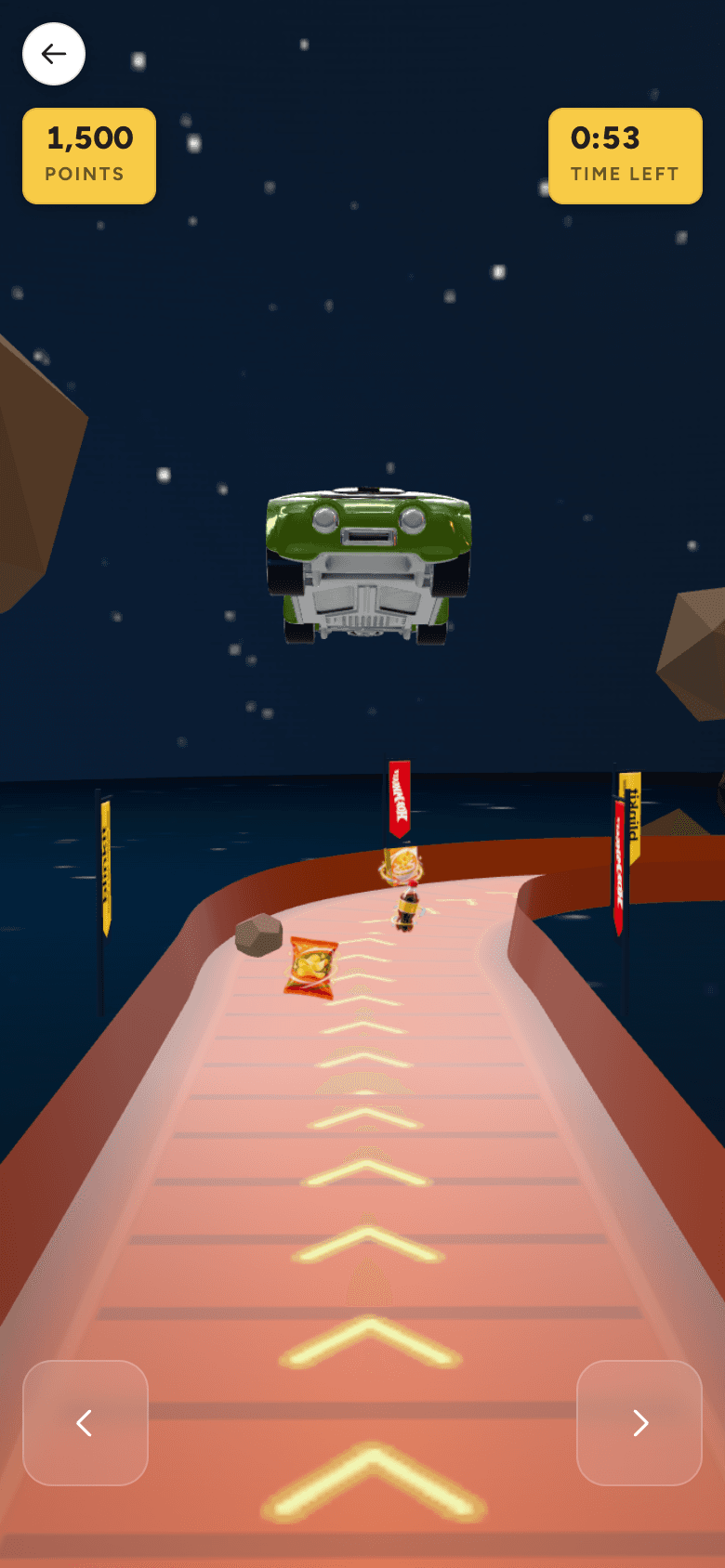
Captured from the built prototype on real devices. The tier is detected at runtime, not chosen by the player. Inside Blinkit’s own app it would run natively: ARCore on Android, ARKit and RealityKit on iPhone, with Scene Viewer (GLB) and AR Quick Look (USDZ) for simply viewing a car.
What it changed
AR became an enhancement rather than a requirement. Every device gets the race. Only the best ones get the room.
Every finding, and what it became.
Nothing here sits on its own. Each row is a number on the left and a decision on the right.
The survey did not tell us which side was right.
It told us the experience had to respect both.