Service design · Artisan economy
Matkarma
A recovery service for broken pottery, that the potter never has to log into.
2026 · Pottery clusters in Hyderabad and Pune
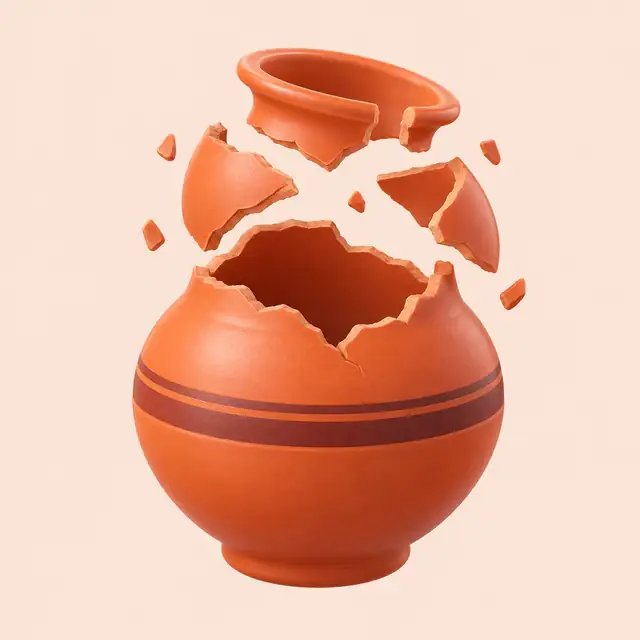
Photos taken with consent. Names are the ones people asked me to use. Interviews were in Telugu, Marathi and Hindi; quotes are translated.
The brief.
Indian potters lose a quarter to a third of every batch to breakage, and none of it goes anywhere. I designed a service that turns that loss back into income, without asking the potter to do anything new.
- My part
- Everything: cluster visits, interviews, the service model, costing, and the field officer’s app.
- Setting
- Pottery clusters in Hyderabad and Pune. Potters, roadside sellers, and the buyers who never find them.
- Status
- Service designed and costed. Field app prototyped. Marketplace screens are next.
The loss, in three numbers
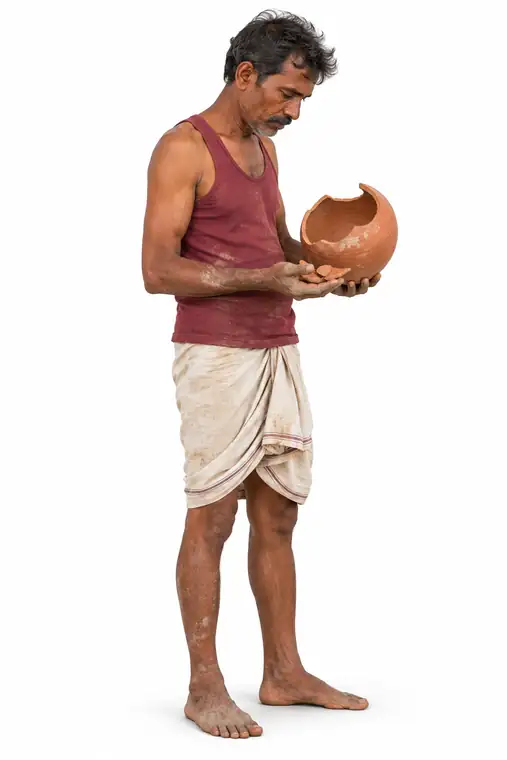
Every broken pot raises three questions
- Who collects it?
- What is it worth?
- Who will buy it?
Today nobody answers any of them, so the pile grows behind the kiln.
Secondary research: four chances to break.
Before the clusters, I traced a pot’s life from wheel to market. It can crack at every stage, and each stage hands the loss to someone.
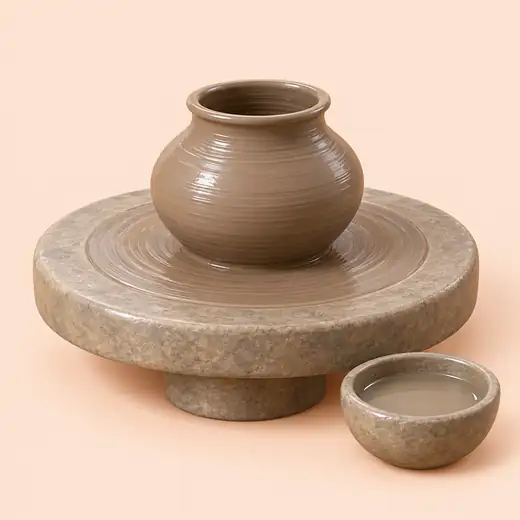 ShapedAt the wheelAn air pocket or an off-centre wall shows up later as a crack.
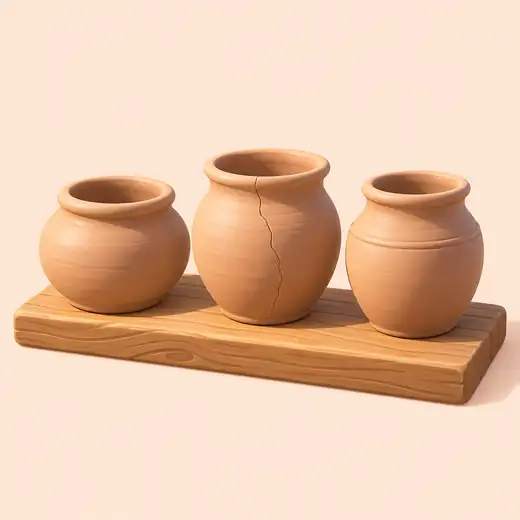 DriedIn the yardUneven sun and wind crack pots before they see any fire.
 FiredIn the kilnOpen kilns heat unevenly. One bad firing erases a week of work.
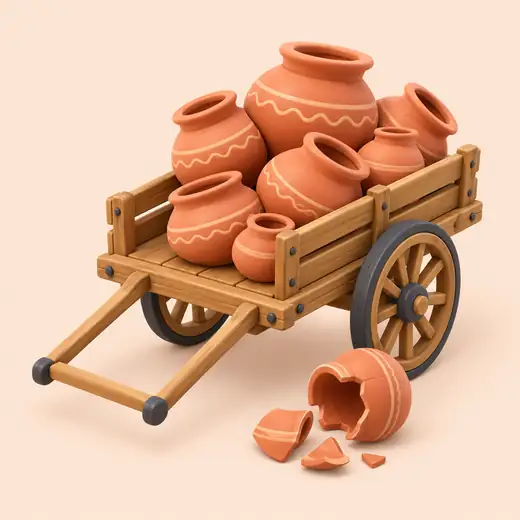 MovedOn the cartEvery load to market loses a few more. The seller absorbs that.
What desk research told me
- Fired clay never becomes clay again. Above 550–600°C it loses its chemically bound water for good. Shards can become grog, aggregate or craft stock, but not new pots.
- Most breakage starts in the kiln. Traditional open kilns are documented as producing weak ware and heavy breakage, which better kiln design reduces (Govind et al., 2022).
- Pottery has no organising layer. Milk has dairy cooperatives and handloom has federations. Pottery has nothing that pools scattered loss into something worth collecting.
- Ground fired clay has a future. It behaves pozzolanically and is studied as a partial cement replacement. It’s the most promising route and the least proven.
Field research: where the wheel turns.
Two weeks in pottery clusters in Hyderabad and Pune. I wanted the workflow under my fingernails, not a checklist of pain points.
- Contextual inquiryWorkshops, kilns, drying yards and markets, 2 weeks
- Interviews12 potters and 6 sellers, long-form
- On the wheelThrowing pots myself, to feel where they fail
- Stakeholder mapBuyers, hubs, CSR, the material’s afterlife


Three things I saw
- Storage is a burden, not just a cost. Sharp piles build up in already cramped workshops. They’re a hazard, and a quiet reminder of lost work.
- There is no word for sorting. Broken pieces are just rubbish. No one has a way to describe shards, because there has never been a reason to.
- The digital divide is real. Most potters don’t own a smartphone. Those who do use it for calls and voice notes.
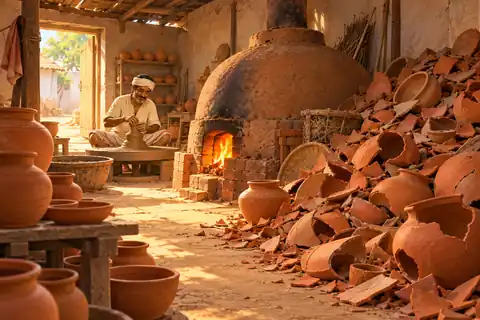
Two people, one loss.
The potter absorbs breakage at the kiln. The seller absorbs it again on the cart. Neither has a word for the pile, and neither has ever been offered anything for it.
RameshPotter · Hyderabad cluster
“I am paid for the pots that survive. The rest I stack behind the kiln and forget.”
Pain points
- 25–30% breakage in firing and transport
- Depends on middlemen, margins paper thin
- No route to city buyers except through someone else
Goals
- Get paid for the pots that break, not only the ones that survive
- Sell beyond the two vendors he has used for 20 years
Needs
- Recovery on the 25–30%, with no new work on his side
- A price he can check on the spot, in front of him
Habits
- Wheel from dawn to noon, fires in the afternoon
- Piles broken pots aside with no system
- Phone for calls and voice notes only
BhagyammaPot seller · Roadside stall, Pune
“Every load that comes in, some of it arrives already broken. That is my loss, not his.”
Pain points
- Pots break in transport, with no recovery
- Seasonal dips leave unsold stock
- Cheap plastic squeezes her prices
Goals
- Stand out with good earthen pottery
- Upcycle or resell broken pots
Needs
- A way to recover breakage losses
- Somewhere to store stock between seasons
Habits
- Up before dawn to stack the stall
- Tracks sales in her head, no records
- Repeat customers and word of mouth
What changed my mind
I arrived to build a selling tool for potters. Two days in, I’d watched Ramesh use his phone for exactly two things.
Calls and voice notes. The pile behind his kiln wasn’t a listing problem. It was a logistics problem nobody had turned up for.
The problem: nobody is counting it.
This isn’t a pricing problem or a marketing problem. It’s an infrastructure problem, and its costs compound.
- MaterialClay, glaze and fuel
Paid for once, then lost for good. Fired clay can’t be reworked.
- LabourHours, days, a kiln cycle
Time at the wheel, days of drying, a full firing. None of it comes back.
- PrideGood work becomes rubbish
The most cited frustration wasn’t money. It was watching finished work get thrown out.
The gaps I was actually solving
Why prevention comes first
Prevention
Sold by the pieceA pot that survives drying, firing and transport sells whole, at the full value of the clay, fuel and labour in it.Needs no infrastructureRecovery
Sold by the kiloOnce broken, the same pot only ever sells as material, priced by weight, whatever it was.Needs collection and transportDeliberately unquantified. I didn’t collect verified output or price figures, so I won’t put a rupee number on it. The ordering holds without one.
What I took from it.
How might we
Recover the loss from broken pottery by building infrastructure around the artisan, rather than putting tools in their hands?
Every obvious fix (list it, photograph it, sort it, sell it) puts new digital work on the potter, and assumes a phone most of them don’t have.
Four questions inside it
- ValueGet value out of breakage
without putting new work, new tools or a smartphone in the artisan’s hands?
- PriceGive shards a grade and a price
when neither the material nor the trade has ever had a way to describe them?
- DemandReach the buyers who already want this
at a volume that makes collecting worth doing in the first place?
- PreventionBreak fewer pots to begin with
because a pot that survives sells by the piece, and a shard only ever sells by the kilo?
The move: take the smartphone out of the artisan’s hands, and put the system on the two people who were always going to hold one, the field officer and the buyer.
Assumptions I designed for
Ideation: three problems, three versions.
The model went through three versions. Every idea below was tried on paper or in a spreadsheet, and most were dropped for a reason.
1Who does the work
Every first idea quietly gave the potter a new job.
- DroppedA selling app for pottersRamesh used his phone for exactly two things: calls and voice notes.
- DroppedPhotograph and list your shardsIt puts more work on the person already losing the money.
- KeptA field officer on a weekly routePotters in a cluster live within walking distance. One route serves all of them.
- RefinedThree tiers of participationDrop-and-done by default. Making mosaics or selling direct are optional, never required.
Chosen: A person, a route and a rate card, instead of an app on the potter’s phone.
2How shards get a price
Shards had no grade, no words for them and no price.
- RefinedFive grades became threeFive was fair on paper but slow to call in a yard. A, B and C, by piece size.
- KeptWeigh and grade in front of the potterTrust has to be earned on every visit, in plain sight.
- KeptOne public rate cardSame rate for everyone in the cluster, printed on every slip.
- DroppedPrice it later at the hubPay-later is exactly what middlemen already do.
Chosen: Weigh, grade and pay on the spot, at a published rate the potter can check.
3How big to start
My first model was a full cooperative. Costing it changed the plan.
- DroppedHubs for 40–80 potters from day oneCollection was never the constraint. The volume had nowhere to go.
- RefinedMembership and a yearly dividendKept for the mature model, not the pilot.
- KeptOne anchor buyer before fifty pottersSize collection to a commitment, not to hope.
- KeptPrevention before collectionThe officer’s first job is advice: kiln, drying, packing.
Chosen: One cluster, one officer, one conversion point, sized to one committed buyer.
How the model changed
- v1 · A cooperativeHub-and-spoke, modelled on dairy co-ops. 50 potters, three sales channels.
- v2 · A pilotOne cluster, one field officer, one conversion point. Prevention first.
- v3 · Demand-ledA CSR anchor buyer sets the volume. Collection follows it.
The service: one route, one rate card.
A field officer runs a weekly route through the cluster, advises on what caused the breakage, then weighs, grades and pays for what broke anyway, in front of the potter.
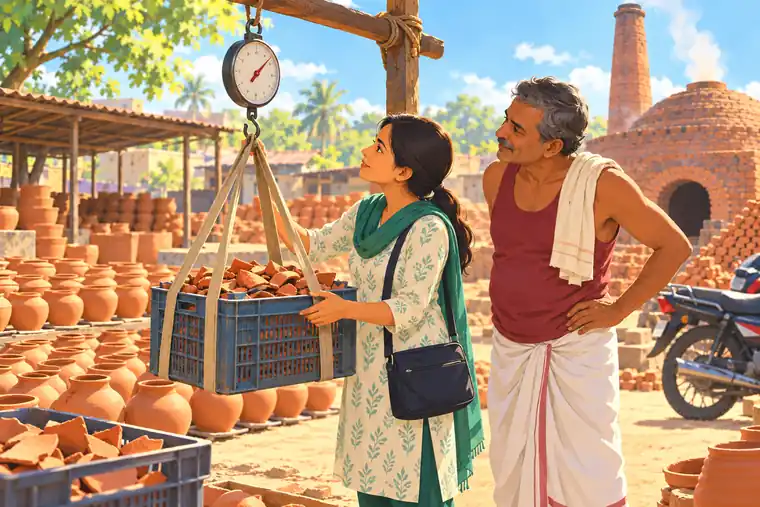
Service blueprint. The line isn’t the usual line of visibility. It marks who has to operate software, and who doesn’t.
From cracked pot to sale
- 01A pot breaksIn drying, firing or transport. Now it has somewhere to go.Potter
- 02Weekly pickupThe officer arrives on a fixed route and weighs the pile.Field officer
- 03Paid on the spotCash in hand and a printed slip. Logged on the phone.Field officer
- 04Hub intakeSorted by grade and colour, cleaned and stocked.Hub
- 05Converted locallyMosaic artisans and grog makers within ~50 km.Hub
- 06BoughtBy the piece, by the kilo, or as a CSR programme.Buyer
Three doors, the potter picks
Tier 01 · Default
Drop and doneMost potters. Set shards aside, get paid at the rate card. No time, no tech.Tier 02 · Optional
Artisan makerPaid per piece to turn shards into mosaic work. The hub lists and sells it.Tier 03 · Advanced
Direct sellerYounger, digitally fluent potters, onboarded by the field officer.Where it goes: demand is the scarce input.
Fired clay can’t become clay again, so recycling is off the table. But stakeholder mapping turned up six routes where the damage doesn’t matter, or is wanted.
- Film and set designProps read better weathered. A chipped rim is a feature.
- Cafés and interiorsShard walls, planters and counters, bought for texture.
- Mosaic and craftArtisans turn shards into surfaces that sell by the piece.
- Workshops and studiosClasses need cheap, forgiving material in bulk.
- Farm boundary markersFound in the field, not in a report. Durable and local.
- Ground clay additiveA partial cement replacement. Promising, least proven.
Three channels, one inventory

Sells by the piece
RetailFinished mosaic work and craft kits. Best margin, smallest volume.
Sells by the kilo
BulkGraded shards for landscapers, set designers and fit-outs. Moves tonnes, pays little.
Buys the programme
CSROne company commits to a livelihoods programme and a volume up front.Load-bearingCosting it broke my first model
The thing that makes it work
Supply was never scarce. Demand is.
A service built around collecting harder solves a problem that doesn’t exist. That’s why CSR isn’t a nice-to-have channel. One company committing to a livelihoods programme creates demand no single buyer can, and collection can finally be sized to something real.
Sizing the pilot
- 01Prevention before collection.
A pot that never breaks sells whole at its piece price. A broken one can only ever sell by weight. So the officer advises on kilns, drying and packing first.
- 02Convert within ~50 km.
Shards are dense and cheap. Freight is the binding constraint, so conversion stays local.
- 03One anchor buyer before fifty potters.
Every potter I met had more breakage than they knew what to do with. The pilot’s job is to land a buyer, then size collection to it.
Try it: pay for a week’s breakage.
Before the screens, here’s the field officer’s flow working. Weigh, grade, turn the phone to the potter, pay. The slip prints below.
Try it
Pay Ramesh for this week’s breakage.
12.5 kg of mixed shards, grade B. You’re in a drying yard with no signal. Tap the phone like a field officer would.
- Start with Ramesh
- Nudge the weight to 12.5 kg
- Grade it B, mixed with some dust
- Show Ramesh the total, then pay
Rates are illustrative. The payment queues on the phone and syncs later.
11:48Offline · 1 waiting to sync
Today’s route
6 stops
- LakshmiKummari Basti✓ Done
- RameshKummari BastiNext
- BhagyammaPochampally
- SattaiahPochampally
The field officer’s tool.
Keeping the potter off software puts the whole digital surface on one role. The brief for that tool is a place, not a feature list.
One transaction, five screens, no menu
11:48Offline · 1 waiting to sync
Today’s route
6 stops
- LakshmiKummari Basti✓ Done
- RameshKummari BastiNext
- BhagyammaPochampally
- SattaiahPochampally
11:48Offline · 1 waiting to sync
Ramesh · Kummari Basti
11:48Offline · 1 waiting to sync
Grade · 12.5 kg
11:48Offline · 1 waiting to sync
↻ Facing Ramesh
12.5 kg × ₹8
₹100
Grade B · Mixed, some dust
11:48Offline · 2 waiting to sync
₹100 paid to Ramesh
In cash. His slip has printed.
Saved on this phone. It syncs when you’re back in range.

The turn-around screen
- 12.5 kg × ₹8 = ₹100
Weight, rate and total at the same size, facing the potter, before Pay can be reached. Trust is the reason a week of breakage gets handed to a stranger on a motorbike. It has to be earned in front of them, every visit.
App 01 · Desktop-first
The marketplaceRetail, bulk and CSR buyers see what the hub actually holds, and commit to volume. Designing next.App 02 · Mobile, offline
The field officer’s toolRoute, weigh, grade, pay, slip. What’s logged on the route is what the marketplace can sell.Where it could fall apart.
A cooperative fails on operations, not on the idea. These are the places I expected it to break, and what’s designed in.
- 01Why would a potter trust us?Middlemen have a long history here.
Designed in: Cash on the spot, a public rate card, and a slip every time.
- 02Quality disputes“That pile was worth more.” Both directions.
Designed in: Three plain grades, a photo on intake, and the screen turned to the potter.
- 03No signal on the routePayments can’t wait for a network.
Designed in: Offline by default. Payments queue and sync in range.
- 04Sharp, heavy logisticsShards cut hands and are costly to move.
Designed in: Standard intake bins, gloves, and conversion within ~50 km.
- 05Seasonal cash flowDemand is festival-driven. Lean months hurt.
Designed in: Advances against future pickups, modelled on dairy co-op credit.
- 06Festival surgesDiwali and weddings spike breakage.
Designed in: Hub overflow storage, and year-round retail to smooth supply.
- 07Bypass riskWhy not buy straight from the potter?
Designed in: The value is grading and volume. One potter can’t fill a bulk order.
- 08Remote pottersVillages with no hub nearby.
Designed in: Dense clusters first. Fortnightly routes later.
What I learned.
Subtraction is a design move.
The strongest decision was removing the screen from the person the project was for. The service got better.
Cost the model before scaling it.
I spent weeks making collection scale before the numbers showed collection was never the constraint.
Watch what the phone is for.
Two days of seeing a phone used only for calls changed the brief from a selling app to a logistics service.
What I’d test next
- Run one route for a month and see whether potters keep setting shards aside.
- Hold one real anchor-buyer conversation before collecting a single kilo.
- Test the turn-around screen at noon, in a yard, with slip on my hands.
Jo toota, wo bhi kaam aaye.Let what broke also be of use.
Research, photos, the service model, costing, screens and design decisions are my own. Illustrations were generated from my field notes.