A recovery service the artisan never has to log into.
Indian potters lose 25–30% of every batch to breakage and recover none of it. Over eight weeks — two of them in pottery clusters in Hyderabad and Pune — I designed a service that turns that loss back into income, and costed it hard enough to know what size it has to be. The artisan never touches software. One person does, and phase two is their tool.
The brief, in a paragraph
Indian potters lose 25–30% of every batch to breakage, and there is no system to recover any of it. I designed a service that does: a field officer who visits, advises on the causes of breakage, then weighs, grades and pays cash on the spot for what broke anyway, routing it into local craft production. The artisan never touches an app. I then costed the model end to end, and that costing set its size — local, small, and built around a handful of potters rather than a regional network. Phase two designs the field officer's tool.
Chapter 01
Context
One of the world's oldest crafts, and one of its most overlooked.
Indian pottery demands precision, intergenerational skill, and decades of practice. It also sits at the bottom of the craft economy. A single bad firing erases a week of work, and there is no insurance, no recovery system, no second life for the pieces that don't make it.
Chapter 02
The Problem
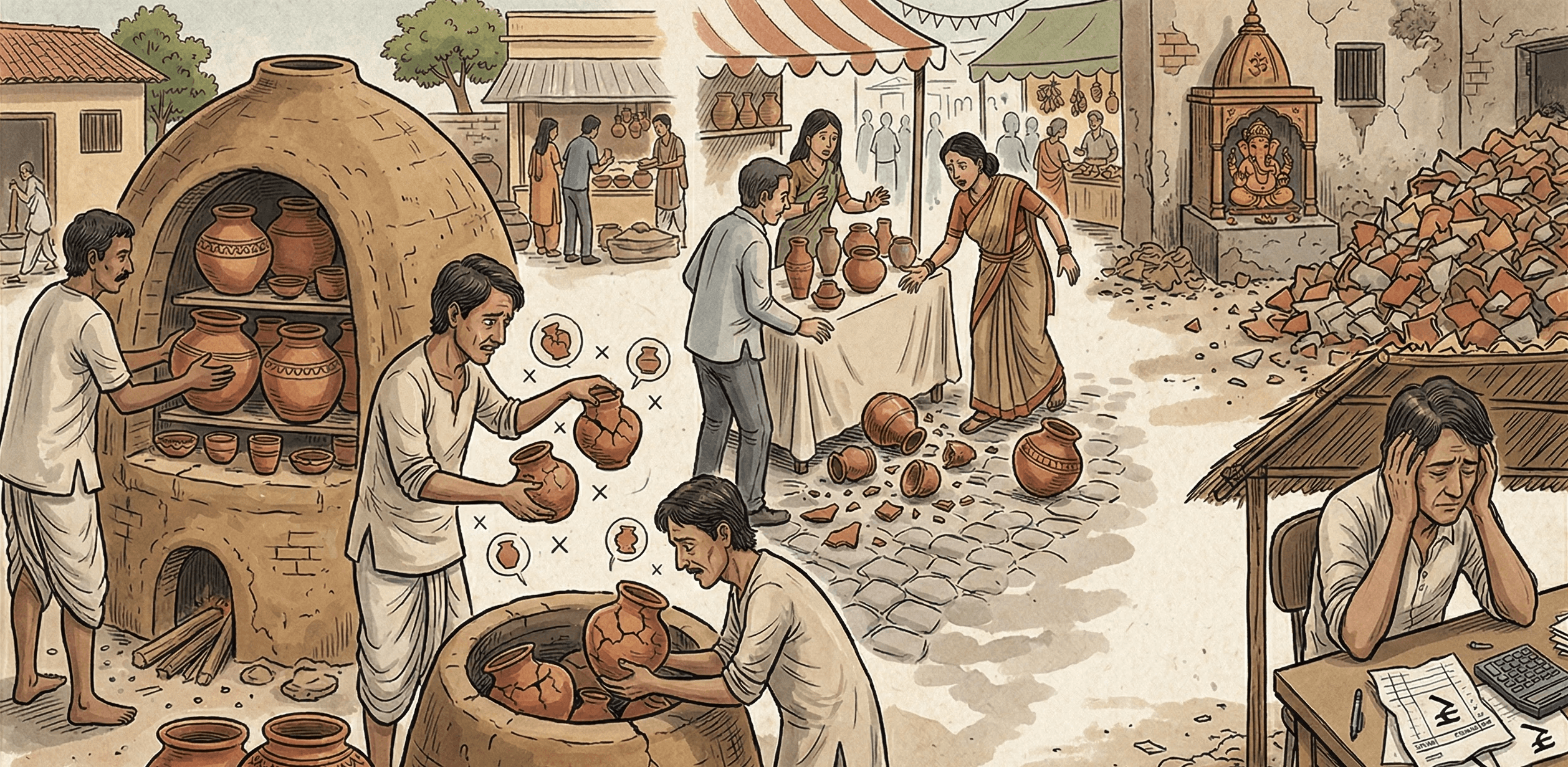
The breakage is constant. The recovery system doesn't exist.
30%
Average material waste
The figure potters quoted themselves, across twelve interviews. Estimates ranged 25–35%. Nobody said less.
0
Recovery routes found
Across both clusters I visited, no route existed for terracotta shards — no resale, no reuse, no collection. Observed, not surveyed.
18
People interviewed
Twelve potters and six sellers across two clusters in Hyderabad and Pune, over two weeks, plus time on the wheel myself.
The three costs compound. Material is lost (clay, glaze, fuel). Labour is lost (hours at the wheel, days of drying, a full kiln cycle). And the most cited frustration in interviews wasn't money, it was watching perfectly good work become trash.
This isn't a marketing problem or a fairer-pricing problem. It's an infrastructure problem.
Chapter 03
Going to the Source
I went to where the wheel turns.
Two weeks across pottery clusters in Hyderabad and Pune. Twelve potters, six sellers, and time on the wheel myself. I wanted the workflow under my fingernails, not a checklist of pain points.
Three observations that shaped the brief.
01
Storage is a burden, not just a cost.
Workshops accumulate sharp ceramic piles in already-cramped spaces. Hazard and silent psychological weight, both.
02
There's no mental model for sorting.
Broken pieces are undifferentiated trash. There's no existing artisan vocabulary for categorising shards because there's never been a reason to.
03
The digital divide is real.
Most artisans don't own a smartphone. Those who do use it for calls and voice notes. A digital product is asking the wrong question.
04 Field Research
What I saw in the workshops, drying yards, and markets.
Watching the wheel turn, sitting through firings, and listening to what frustrated artisans the most.
Field visit · pottery cluster in Hyderabad
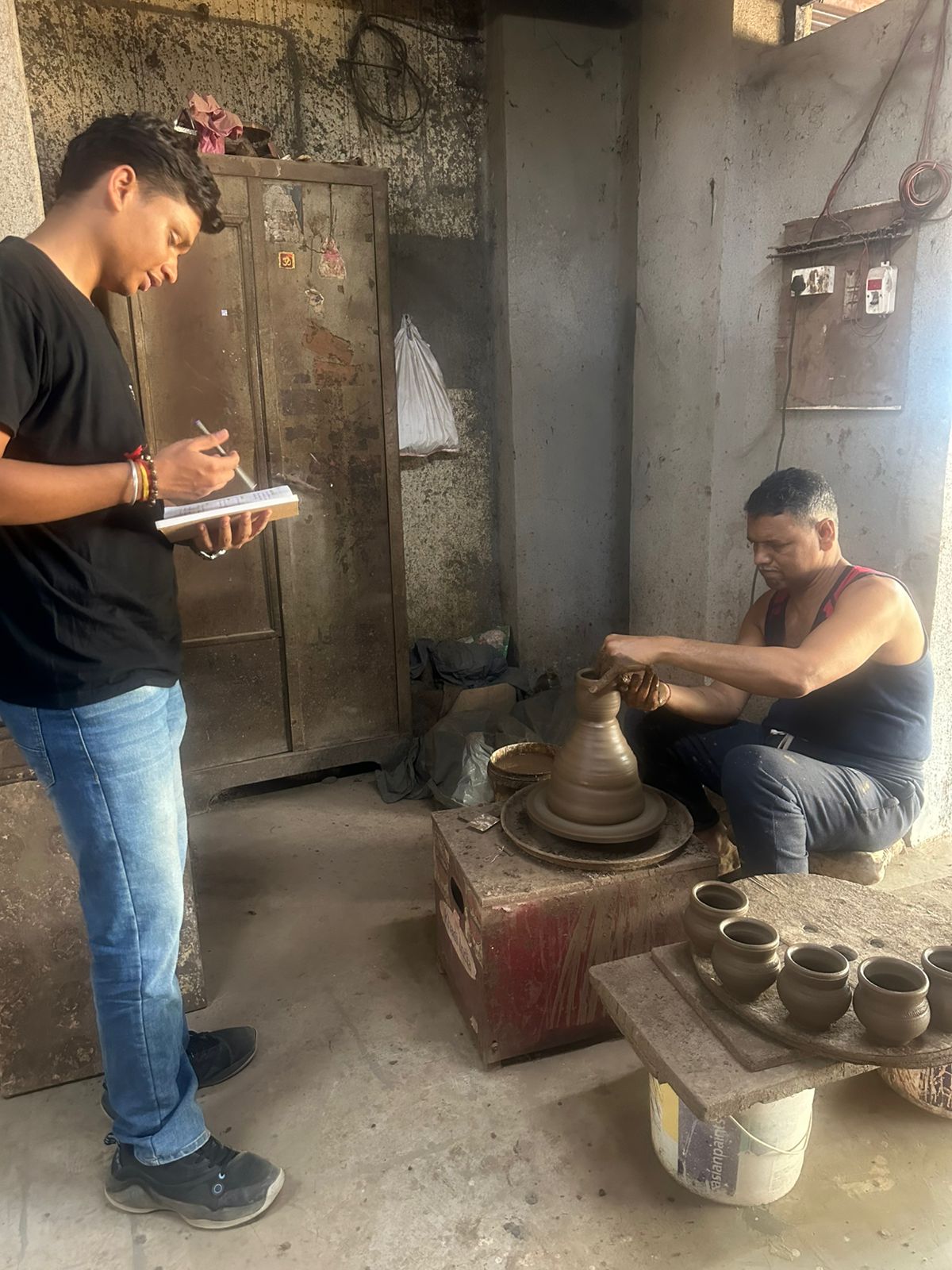
Interview · discussing journey and frustrations
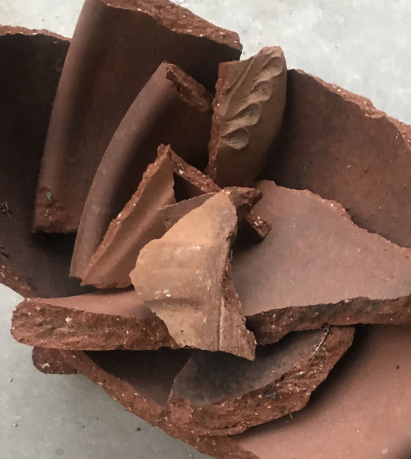
Observation · broken pieces, shapes & sizes
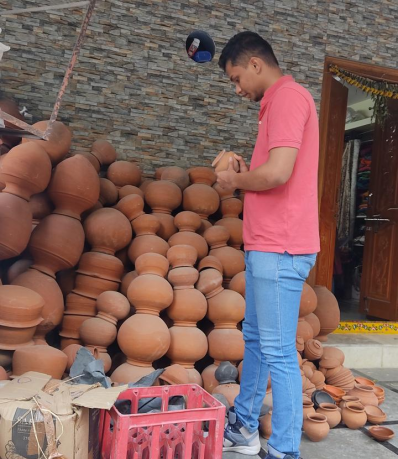
Inspecting · how she organizes her stock
Hands on the wheel.
Time at the wheel · learning what it takes to make a single pot
05 Two Voices
Bhagyamma and Ramesh.
Two interviews that shaped how the service needed to behave, what to build around, and what to never put on the artisan.
06 The Realization
The labour of recovery shouldn't fall on the person already absorbing the loss.
Any solution that placed new digital work on the potter, listing, photographing, sorting, would re-tax the artisan who was already losing the money. That single decision shifted everything that came after it.
How Might We
How might we recover the financial losses from broken pottery by building infrastructure around the artisan, rather than putting tools in their hands?
Chapter 07
The Service Model
Matkarma is a cooperative, not an app.
A hub-and-spoke system modelled on India's dairy cooperatives. Potters set broken pottery aside and receive cash on the spot; hubs handle sorting, grading, packaging and sales; revenue returns through three channels and an annual dividend. This is the service at maturity — the shape it takes once demand supports it.
The Hub-and-Spoke Model
Supply · No app required
Artisans
2 villages · 50+ potters
↓ Sets shards aside
Field Officer
Weighs · pays · logs
Cash paid on the spot
⟶
Kumhar Kendra
Collection Hub
Sort · Grade · Route
⟶
Demand · Online
B2C Retail
Kits · Art
B2B Bulk
Architects · schools
Brand Co-create
Decor · CSR · carbon
⟲ + annual cooperative dividend flows back to the artisans
Layer 01
Physical
Kumhar Kendras, small hubs inside pottery clusters. Catchment sized at 40–80 potters within 5km — a planning assumption from cluster density I observed, not a surveyed figure.
Layer 02
Human
Field officers on motorbikes. Weekly routes. Weigh, pay, log, building trust over time.
Layer 03
Digital
Two surfaces: a buyer-facing storefront and a field-officer tool. Neither touches the artisan.
Chapter 08
Where The Software Goes
Two surfaces. Neither of them belongs to the artisan.
Two phones, two users, and the artisan holds neither. The buyer side is a storefront; the field side is the tool that carries the transaction. Only one of them is bespoke, and it is the one standing in the drying yard.
matkarma
Search kits, art…
All
Kits
Art
Mosaic Kit
₹449
Artisan Vase
₹1,200
User · Urban Buyer
Marketplace
The demand side, where urban buyers reach the finished pieces.
matkarma
FIELD
Today's Route
Kummari Colony
Hyderabad cluster · 8 stops
New Collection
Weight (kg)
12.5
Grade
Mixed ▾
Payment Summary
12.5 kg × ₹8/kg
₹100
Total
₹100
Pay Artisan · UPI / Cash
User · Field Officer
Field App
Weigh, grade, pay the artisan on the spot, log the collection. This is the surface the whole service depends on, and the one worth designing properly — phase two builds it.
Uses the app
The urban buyer
Uses the app
The field officer
Does not
The artisan
Chapter 09
The Channel Economics
One inventory, three channels, each with a different job.
No single channel carries broken pottery on its own — margin, volume and cashflow sit in different places. Layering all three is what lets the service price the same inventory three ways. The next chapter tests each of them against what the operation has to earn.
Channel 01 · B2C
Direct to Buyer
The margin channel. Kits and finished pieces clear ₹100+/kg, which is where the service actually earns. Volumes are small, so this sets the ceiling on price rather than the floor on tonnage.
Channel 02 · B2B
Bulk & Trade
The clearance channel. Grog and aggregate absorb whatever craft can't use, at ₹10–25/kg. It keeps material moving rather than piling up, but it is priced too thin to fund the operation on its own.
Channel 03 · Brands
Co-Creation & CSR
The anchor channel. Brand and CSR projects pay real money and set the reference price everything else is quoted against. It arrives project by project, so it funds bursts of work rather than steady throughput.
Chapter 10
Testing the Model
Costing the model is what set its size.
By week six the service was designed, so I ran it as a P&L before committing to it: fifty potters, 75–100 tonnes of shard a year, roughly ₹22–27 lakh to collect and move. That version needs about ₹25 a kilo to break even. Testing each channel against that number told me exactly which parts of the model were load-bearing and which were ambition — and it is the reason the final service looks the way it does.
01
Fired clay never becomes clay again.
At around 550–600°C the clay mineral loses its chemically bound water and will not take it back. Unlike glass or metal, a fired pot can never return to workable clay. That caps every downstream option to three — crushed grog, drainage aggregate, or mosaic and craft — and it is the constraint the entire service has to be designed around.
02
Volume and margin sit in different channels.
Grog and drainage aggregate are the only outlets that can swallow 90 tonnes, and they pay ₹10–25/kg — at or below break-even before a truck moves. Craft retail clears ₹100+/kg but shifts single-digit tonnes. Freight settles it: on something this dense and this cheap, moving it costs more than it is worth past about 100km. So the service has to be built on margin, close to the source — not on tonnage.
03
The scarce input is buyers, not shards.
Every potter I met had more breakage than they knew what to do with, so aggregation was never the hard part. The economics that work are low volume and high value-add, where the shard is a fraction of the cost and the whole of the story. That points the service at demand rather than collection — and at a handful of potters rather than fifty.
Chapter 13
The Field Officer
The one role the whole service rests on.
Keeping the potter off software puts every digital decision on one person: the field officer. They advise on prevention, then weigh, grade and pay for what broke anyway — in a drying yard at noon, with clay on both sets of hands, while the potter watches the screen to check the price is fair. Those conditions are the real design brief, and phase two is where I build for them.
01
Readable in full sun, workable with wet hands.
High-contrast numerals, no fine print, targets sized for a thumb that just handled a shard. The field officer's hands are rarely clean or dry.
02
The potter reads the screen before the money moves.
Weight and grade render huge, turned toward them, before the officer touches the pay button. Trust was the whole reason a stranger on a motorbike gets handed a week's breakage.
03
Offline, and it still ends in a receipt.
Villages don't guarantee signal. Weigh, grade, and pay queue locally and sync when connectivity returns. A printed slip is proof that survives no matter what the phone does.
Chapter 14
Reflection
The hardest design decision was where to design.
For most of this project, the obvious move was to build something: an app, an interface, a product.
The strongest design move I made was a subtraction: pulling the smartphone out of the potter's hands.
Costing the model is also what set the order of operations inside it. A pot is sold by the piece; its shards can only be sold by the kilo. So preventing a break returns the whole piece price, while recovering one returns a material rate — and no amount of logistics closes that gap. The service therefore advises first and collects second.
Takeaway
Designing for a user and designing around a user are different jobs. Working out which problem deserves either one is a third.